If you are planning a holiday with the goal of rushing frantically from one crowded beach club to another, elbowing your way through the masses to snap a quick selfie in Alberobello before squeezing back into a scorching rental car stuck in coastal traffic… let us stop you right there: this guide is probably not for you.
The true, authentic magic of Salento—this sun-drenched strip of land that forms the very heel of Italy’s boot—reveals itself exclusively to those who have the courage, the patience, and the wisdom to slow down.
Welcome to your ultimate Puglia Survival Guide. We are Carlo and Gloria. A few years ago, we made the life-changing decision to leave the fast-paced daily rush, the suffocating schedules, and the relentless clockwork precision of Milan in Northern Italy to relocate permanently to Ugento, a quiet, sun-drenched town in the deep south of Salento.
Moving here taught us a profound lesson. We hit an invisible wall and had to unlearn everything we knew about modern productivity to learn a fundamental rule, one as ancient as the millennial olive trees that surround our home: Puglia cannot be rushed. Time beats to an intrinsically different drum in the Mediterranean basin. Urban rhythms, the anxiety of ticking off a bucket list, and the pursuit of efficiency at all costs simply do not work here.
What you are reading is not a standard, glossy guidebook written by a travel blogger who spent a sponsored weekend here in August. This is our practical, boots-on-the-ground manual, tested on our own skin every single day. Whether you are visiting for the first time or returning to explore deeper, this survival guide will give you the practical knowledge, local etiquette, and insider secrets needed to navigate Puglia like a true local, avoiding the tourist traps and embracing the authentic soul of the region.
1. What “Slow Travel” in Puglia Actually Means
You will often hear the term “slow travel” thrown around online, but in Puglia, it is not a passing trend, a hipster fad, or a hashtag for social media; it is literally the only key to deciphering this territory.
Most travel itineraries force tourists into a chaotic race: Bari in the morning, Polignano a Mare at noon, and Alberobello by sunset. Doing this means spending your entire vacation stressed out, exhausted, and missing the very essence of the region. Mass tourism demands efficiency and “Top 10 things you must see in 3 days” lists. Salento, on the contrary, demands mindfulness. It means shifting your perspective from “seeing everything” to “experiencing deeply.”
Practicing slow travel means intentionally getting lost along intricate, winding country roads (the famous strade interpoderali) without blindly following your smartphone’s GPS. It means pulling the car over to chat with an elderly farmer who is repairing a dry-stone wall or harvesting prickly pears. It means choosing local family-run trattorias over commercial tourist traps, staying in historic town centers rather than isolated mega-resorts, and accepting that a flat tire, an unexpected detour due to roadworks, or a sudden summer thunderstorm is just the beginning of a new, incredible discovery you could never have planned.
When you slow down, you start to notice the details: the intoxicating scent of wild thyme and wet red earth, the twisted, tortured patterns of the olive tree trunks that look like living sculptures, and the genuine hospitality of people who are in no rush.
📍 Local Tip by Carlo & Gloria: “Back in Milan, our holidays were always a race against time. The moment we completedour journey from Milan to Ugento, we realized that the greatest luxury in Salento is sitting on a stone bench at sunset, enjoying a fresh pasticciotto or frisella, and listening to the local elders share stories in dialect. Slow down—Salento only reveals its real magic when you take your time and respect the natural rhythms of the land.”
2. Timing Your Visit: A Month-by-Month Survival Guide
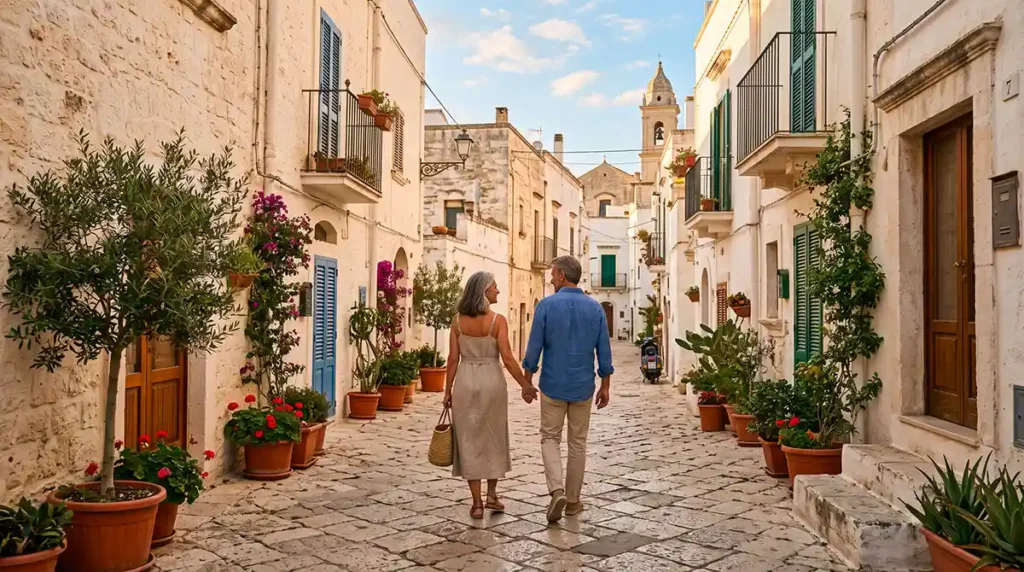
Timing is everything when planning a slow trip to Southern Italy. If you want an authentic experience, you must strategically choose when to book your flights.
During mid-summer, temperatures soar well above 35°C (95°F), prices for flights and accommodations double, small coastal roads become congested, and the famous beaches are packed shoulder-to-shoulder with domestic tourists. By embracing a slow travel approach, you step away from the commercial noise. Here is our insider breakdown of the best seasons to visit Basso Salento:
May to June: The Spring Awakening
This is absolute perfection. Wildflowers carpet the coastline, transforming the red earth into a vibrant mosaic of colors. Temperatures are warm but pleasant (22°C–27°C), and the sea is calm and refreshing. It is the perfect time for early swims, exploring ancient Roman ruins without the sweltering heat, hiking along the coastal cliffs of the Otranto-Leuca natural park, and enjoying the beaches almost entirely to yourself. The locals are relaxed, and restaurant reservations are easy to secure.
July and August: The Peak Chaos (How to Survive It)
If you can only travel in August due to work or school schedules, be prepared. This is when all of Italy goes on vacation (the famous Ferragosto period). The beaches will be incredibly crowded. To survive August in Salento, you must adopt local habits: wake up at 6:30 AM to go to the beach, leave by 11:30 AM before the masses arrive, sleep during the afternoon heat, and only venture out for dinner after 9:00 PM.
September to October: The “Golden Months”
Known locally as the absolute best time to visit. The sea remains wonderfully warm from the summer heat (you can easily swim until late October), but the heavy crowds disappear as Italian schools reopen. The harsh summer light turns soft and golden, perfect for photography. This is also when the grape harvest (vendemmia) and early olive harvests begin. Local food festivals (sagre) celebrate the new wine, offering a deep dive into the region’s agricultural traditions.
November to April: True Local Immersion
Ideal for budget travelers, digital nomads, and those seeking absolute tranquility. While swimming is off the table, this is the time for cultural immersion. You can experience authentic village life, observe the pressing of the extra virgin olive oil in the frantoi (olive mills) in November, and enjoy traditional Christmas markets in December, eating warm pittule (fried dough balls) by the roaring fires. You will likely be the only foreigner in the piazza, guaranteeing a 100% authentic experience.
3. The Golden Rule of Salento Beaches: Scirocco vs. Tramontana
Here is the most common and catastrophic mistake made by first-time visitors to Puglia: waking up, opening the map on their phone, and deciding to drive to the most famous beach without checking the weather forecast.
In Salento, the sun does not dictate the rules; the wind does.
Being a narrow peninsula (the famous “Heel” of Italy), we have the Ionian Sea on the west and the Adriatic Sea on the east, often separated by just a 30-to-40-minute drive. The sea here is not inherently “good” or “bad”; it depends entirely on how the wind is blowing at that exact moment. Memorize these two golden rules for beach survival:
When the Tramontana blows (North Wind)
The Tramontana is a cool, dry wind blowing down from the Balkans in the North. When it blows, you must head to the Ionian Sea (the western coast). Locations like Gallipoli, Ugento, Torre San Giovanni, and the famous “Maldives of Salento” at Pescoluse will be completely protected. The sea will be as flat as a swimming pool, perfectly calm, crystal clear, and ideal for swimming. The Adriatic side, however, will be choppy, windy, and rough.
When the Scirocco blows (South Wind)
The Scirocco is a hot, humid wind blowing across the Mediterranean from the Sahara Desert in Africa. When this happens, you must do exactly the opposite! Flee from the Ionian coast, which will turn into a washing machine full of crashing waves, murky water, and floating seaweed. Instead, seek refuge on the stunning rocky coasts of the Adriatic Sea (the eastern coast). Spots like Otranto, Castro, Porto Badisco, Santa Cesarea Terme, and the breathtaking fjords of Ponte Ciolo will be magically calm, transparent, and perfect for snorkeling.
📍 Local Tip by Carlo & Gloria: “Our very first year living here was a total meteorological disaster. Completely ignoring this rule, on a scorching hot day with strong Scirocco winds, we stubbornly insisted on going down to the Ionian beach near our house. We were met with a stormy, murky sea filled with seaweed. An elderly local fisherman looked at us, smirked under his mustache, and told us in the thick local dialect: ‘Osci tocca sciati all’addhra parte!’ (Today you need to go to the other side). Since that day, the very first thing we do every morning while brewing our coffee is open the weather app. The wind dictates our itinerary! To master this skill, check out our dedicated guide onHow to Choose the Best Beach in Ugento Based on the Wind.”
4. The Morning Rhythm: Sunrises, Sea Glass, and Mindfulness
If there is one unwritten piece of advice that we can give you to experience Salento at its absolute purest, it is to set your alarm clock at least two hours before the rest of the world wakes up.
Forget the heavily crowded midday beaches, the desperate hunt for a parking spot, the blasting music from the beach clubs, and the fight for a square meter of sand. The true, intimate connection with nature happens when the sun first peeks over the water, painting the horizon in surreal pastel hues of pink and orange. The morning silence in places like the Ugento Regional Nature Park is broken only by the sound of the surf and the calls of migratory birds.
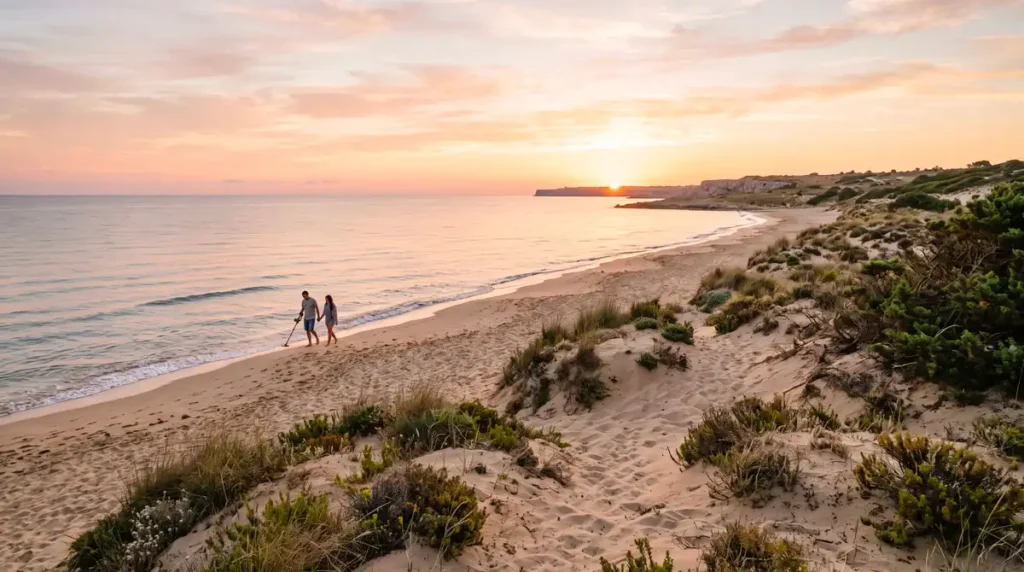
📍 Local Tip by Carlo & Gloria: “For us, the sunrise is not just the beginning of a new day: it is an essential ritual that reconciles us with our choice to change our lives. Often, while tourists are still fast asleep, we grab our metal detector and walk barefoot on the pristine sand dunes near Ugento, caressed by the crisp morning breeze. We love searching for small items lost in the sand by beachgoers the day before, but our true treasures are ‘sea glass’—fragments of glass bottles that the waves, sand, and salt have tumbled and frosted for decades, transforming them into opaque gems. We collect them, return to our home workshop, fire up our jeweler’s torch, and use these fragments to craft handmade 925 sterling silver jewelry. Walking on a deserted beach at 6:00 AM and creating something new out of what the sea has decided to give back is our personal, untouchable daily meditation.”
5. Surviving the Heat: The Sacred Rule of the “Controra”
One of the biggest culture shocks for foreign travelers (and even for Northern Italians visiting the South) is realizing that, from 1:30 PM to 5:00 PM, the world in Southern Italy simply stops.
This is the famous “Controra” (The Mediterranean Siesta). It is not laziness, as many mistakenly assume, but pure and simple survival against the relentless heat of the Mediterranean summer. During these hours, the sun is at its absolute zenith. The heat radiates from the paving stones. Shops lower their heavy metal shutters, pharmacies and supermarkets lock their doors, the piazzas completely empty out, and a surreal, heavy silence falls over the towns, broken only by the deafening, continuous buzzing of cicadas in the olive groves.
Do not try to fight the Controra by booking exhausting walking tours under the blazing sun or desperately searching for an open café to grab a cappuccino: you will end up defeated, dehydrated, and frustrated. Embrace it. This is the time to respect your body. Rest in the cool shade of a stone porch, read a book under a pine tree at your masseria, or take a nap in a room with the shutters drawn.
📍 Local Tip by Carlo & Gloria: “When we first moved here, still trapped in the Milanese loop of constant productivity, we stubbornly tried to run errands, go to the post office, or buy groceries at 2:30 PM. We literally found ghost towns! Today, we have learned to madly love this suspended moment in time. During the Controra, the harsh, direct sunlight intensifies the warm colors of the local limestone (‘pietra leccese’). Since there is not a single soul around, we often take our camera gear to capture the silent alleys, baroque palaces, and ancient courtyards of historic towns. It is the absolute best time for architectural photography without having dozens of tourists ruining the frame. For inspiration on beautiful inland towns to photograph during these silent hours, dive into ourUltimate Ugento Travel Guide.”
Life resumes slowly around 5:00 PM as the heat breaks. Locals dress nicely for the evening passeggiata (leisurely stroll), children return to play in the squares, and the gelaterias open their doors.
6. Navigating the Deep South: Driving, Parking, and Flocks of Sheep
Do you really need to rent a car in Puglia? The short answer is: Yes, absolutely.
While main cities like Bari, Lecce, and Brindisi are well-connected by the Trenitalia regional train network, exploring the authentic inland towns (borghi), historic farms, and hidden coves of Basso Salento requires private transport. Public buses in rural areas run infrequently, especially on weekends, and rely heavily on school schedules.
However, driving in this land requires a profoundly serene state of mind and a bit of local knowledge. Here is how to survive the Apulian roads:
Renting the Right Car (Think Small!)
When booking your rental car, suppress the urge to rent a large SUV. Rent the smallest compact car you can comfortably fit your luggage into. Navigating the ancient rural roads and tight historic centers is a nightmare in a large vehicle. Keep in mind that manual transmission is the standard in Italy; if you require an automatic car, you must book it months in advance.
Beware of the ZTL (Zona a Traffico Limitato)
This is a crucial survival tip that will save you hundreds of euros in fines. Almost every historic town center in Puglia has a ZTL (Limited Traffic Zone). These are areas where only registered residents can drive. They are marked by white signs with a red circle and usually feature traffic cameras. If you drive past one, you will be automatically fined. Always park outside the historic center walls and walk in.
Understanding Parking Lines
- Blue lines: You must pay. Look for a parking meter nearby or use apps like EasyPark on your phone.
- White lines: Parking is free!
- Yellow lines: Strictly reserved for residents, loading zones, or disabled drivers. Do not park here!
The “Strade Interpoderali”
The main state highways are fast and smooth. However, to reach authentic masserias or secret beaches, you will need to drive on the strade interpoderali: extremely narrow country lanes, often only wide enough for a single car, framed by ancient, sharp dry-stone walls (muretti a secco) and giant olive trees.
📍 Local Tip by Carlo & Gloria: “We can assure you that driving in the Salento countryside requires a completely different kind of patience! On our beloved old Citroën C3, we actually custom-installed a 360-degree camera system just so we could maneuver millimeter by millimeter between the dry-stone walls without scratching the side of the car! Today, for our expeditions into the narrowest alleys, we use our small, unstoppable Ford Ka. And when you find yourself stuck on a two-meter-wide road behind a massive flock of sheep moving pastures, make your peace with it. Honking is useless and will only anger the shepherd. Turn off the engine, roll down the windows, listen to the cowbells, and enjoy the show of rural life.”
7. Food & Dining: How to Eat Like a Local and Dodge Tourist Traps
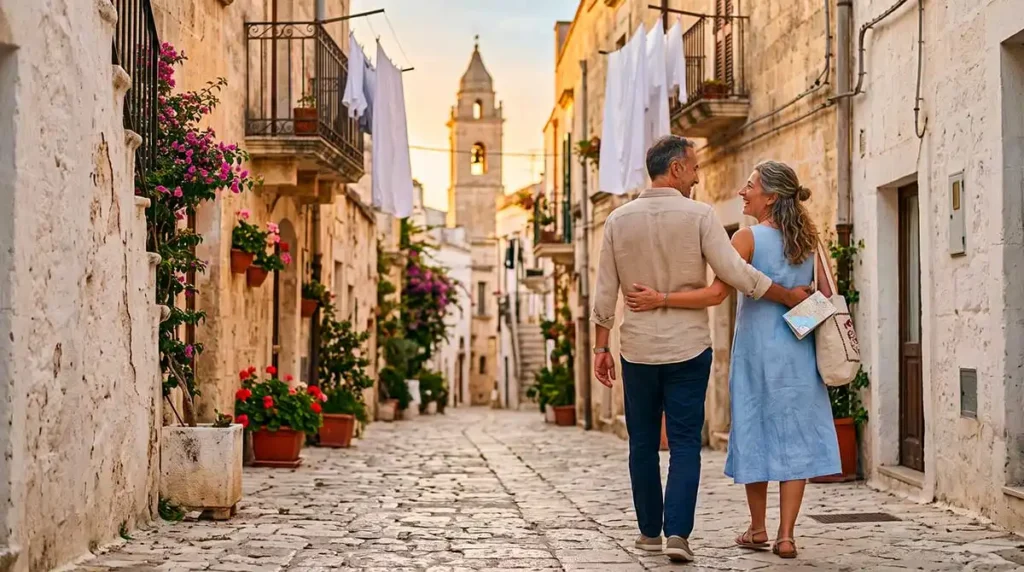
Food in Puglia is not mere sustenance; it is a religion, a family event, and a sacred moment of sharing. Pugliese cuisine—often referred to as cucina povera (peasant cuisine)—is simple, hyper-seasonal, and deeply flavorful. It relies on the absolute highest quality of basic ingredients: wheat, tomatoes, olive oil, and wine.
To experience this, you must learn to dodge the “tourist traps.” Avoid restaurants located directly on the most crowded seafront promenades that display massive plastic menus translated into four languages, complete with faded photos of the food and promoters standing outside insisting you sit down.
True, authentic, and unforgettable Apulian cuisine is found in small, family-run trattorias hidden in the inland alleys, or inside converted old masserie (farmhouses) surrounded by olive groves. If you don’t hear the local dialect spoken at the tables next to you, you are probably paying too much to eat poorly.
The Apulian Breakfast: Caffè in Ghiaccio and Pasticciotto
If you plan on coming to Puglia and ordering a classic American iced coffee or a generic Frappuccino, prepare for some very confused looks. The Apulian summer dictates only one delicious religion: Caffè in ghiaccio con latte di mandorla (Espresso over ice with almond milk syrup). The barista pulls a boiling hot shot of espresso, pours a splash of sweet artisanal almond milk syrup into the glass, and immediately dumps the hot espresso over freshly chipped ice.
It must strictly be accompanied by a Pasticciotto, the iconic Salento breakfast pastry. It is a warm, freshly baked oval-shaped shortcrust pastry generously filled with rich lemon-scented custard cream.
The Savory Mid-Morning Snack
Around 11:00 AM, locals reach for a savory bite. Head to a local bakery (forno) and order a Rustico Leccese—a disc of puff pastry filled with béchamel, tomato sauce, mozzarella, and a hint of black pepper. Alternatively, grab a slice of authentic Apulian focaccia, thick, dripping with extra virgin olive oil, and covered in roasted cherry tomatoes.
Lunch and Dinner Classics
When sitting down at a local trattoria, look for these traditional dishes:
- Orecchiette con Cime di Rapa: The undisputed king of Pugliese pasta. Hand-rolled ear-shaped pasta served with bitter turnip greens, garlic, and a hint of anchovies.
- Fave e Cicorie: The ultimate comfort food of the cucina povera. A creamy puree of dried fava beans served alongside bitter wild chicory, heavily drizzled with raw olive oil.
- Puccia: A soft, round bread baked in wood-fired ovens, sliced open and stuffed with local cheeses, cured meats, and grilled vegetables. Great for a beach lunch.
- Frisella: A hard, ring-shaped dried bread baked twice. It must be soaked briefly in water to soften it, then topped with fresh cherry tomatoes, oregano, salt, and generous amounts of olive oil.
- Crudo di Mare: If you are near Gallipoli or the coast, you must try the local raw seafood (purple shrimp, sea urchins, oysters) eaten fresh with just a squeeze of lemon.
The Unwritten Rules of Italian Dining
- The “Coperto”: Don’t be surprised to see a coperto (cover charge) of €2 to €4 per person on your bill. This is standard in Italy and covers the bread basket, table linens, and tableware.
- Tipping: Tipping is not obligatory in Italy. Service staff are paid a regular wage. However, if the service was exceptional, leaving a 5-10% tip in cash on the table is highly appreciated.
- Dinner Hours: Never show up at a restaurant at 6:30 PM expecting dinner. Kitchens generally open at 8:00 PM, and locals rarely sit down to eat before 8:30 PM or 9:00 PM.
📍 Local Tip by Carlo & Gloria: “Our biggest adjustment moving from Milan was learning how to shop for food. Forget large supermarkets. The secret to eating well in Puglia is buying fresh bread from the local bakery at 8:00 AM, getting vegetables from the ape car vendor parked on the corner, and asking the local butcher what’s fresh today. We love experiencing the territory through the weekly neighborhood farmer’s markets, buying zero-kilometer vegetables and fresh ‘cacio ricotta’ cheese directly from the farmers out of the back of their trucks. If you want to know exactly where to sit down for a guaranteed incredible meal, read our dedicated breakdown inWhere to Eat in Felline: Our Insider Guide to Salento’s Culinary Borgo.”
8. Where to Base Yourself: Coastal Chaos vs. Authentic Inland Towns
Choosing where to set up your “base camp”—the accommodation from which you will depart to explore every day—will completely determine the success of your entire trip.
Our most sincere and unconventional advice? Flee from the chaotic, noisy coastal resorts.
While famous seaside spots like Gallipoli, Otranto, or Torre San Giovanni are beautiful to visit for a few hours, staying there during the high season means dealing with traffic, loud nightlife, and premium prices. The true heartbeat of Salento lies just a few kilometers inland.
By staying in authentic inland villages (like Ugento, Ruffano, Specchia, Felline, or Presicce-Acquarica), you will enjoy absolute peace. You will have direct contact with real local life, find historic shops, discover exceptional restaurants at honest prices, and above all, you will be able to sleep at night without the thumping bass of beach clubs. The beauty of Salento’s geography is that by choosing the inland, you will still remain only a 10-to-15-minute drive from the most famous Caribbean-like beaches on the Ionian coast or dramatic coastal cliffs on the Adriatic.
When choosing your accommodation, look for properties that reflect the local character:
- Masserie: Historic, fortified farmhouses surrounded by olive groves. Many have been restored into stunning boutique hotels with pools and farm-to-table restaurants.
- Palazzi Storici: Noble townhouses located inside the historic centers of small villages, often featuring incredible star-vaulted ceilings (volte a stella).
- Pajare or Trulli: Traditional dry-stone rural dwellings, perfect for a rustic, off-grid experience among nature.
📍 Local Tip by Carlo & Gloria: “To help you make this delicate choice and avoid overpriced tourist traps, we have created a highly curated selection of the best accommodations based on our local knowledge. Visit our comprehensive guide onWhere to Stay in Salentoto discover the wonderful historic farmhouses and charming boutique B&Bs we have hand-picked.”
9. Essential Packing List for Salento
Packing for a slow travel trip to Puglia requires a mix of practicality and laid-back Mediterranean style. Here is what you absolutely must put in your suitcase:
- Water Shoes: While the Ionian side has sandy beaches, the breathtaking Adriatic side is entirely rocky. Neoprene water shoes will save your feet and allow you to dive into the clearest waters effortlessly.
- A Light Windbreaker: Even in the middle of August, if you are dining on the cliffs of Leuca or Otranto at night, the sea breeze can be unexpectedly chilly.
- Modest Clothing for Churches: You cannot enter the stunning Baroque churches of Lecce or local cathedrals in beachwear. Always carry a lightweight scarf or linen shirt in your bag to cover your shoulders.
- Comfortable Walking Shoes: Leave the high heels at home. The historic centers are paved with ancient chianche (smooth limestone slabs) or uneven cobblestones.
10. A Mini Salentino Dialect Survival Kit
Locals will absolutely love it if you try to speak a few words of standard Italian (like Buongiorno and Grazie), but if you drop a word in the local Salentino dialect, you will instantly be treated like family! The dialect here sounds completely different from standard Italian.
- Mena! = Come on! / Hurry up! (Used in almost every sentence).
- Beddhru / Beddhra = Beautiful. (You will hear locals calling children or even fresh produce this).
- Ieu = I / Me.
- Sciamu = Let’s go!
- Lu sule, lu mare, lu jentu = The sun, the sea, the wind. (The unofficial motto of Salento).
11. Frequently Asked Questions About Visiting Puglia
Is Puglia safe for foreign travelers and solo tourists?
Yes, absolutely. Puglia is one of the safest regions in Italy. Local communities in the south are incredibly welcoming, deeply family-oriented, and violent crime rates are extremely low. Normal travel safety precautions apply, such as watching your belongings in busy train stations or crowded markets, but you will feel very safe walking around small towns at night. The biggest “danger” you will face is a local grandmother trying to overfeed you!
Cash vs. Cards: What should I bring?
While all hotels, supermarkets, and large restaurants accept credit cards (Visa and Mastercard are widely accepted, American Express much less so), cash is still king in Salento. You will need euros for buying coffee at a small bar, paying for a sunbed at a local lido, buying vegetables at the farmer’s market, or leaving a small tip. Always carry €50-€100 in small bills.
Is the tap water safe to drink?
Yes, tap water in Puglia is generally safe to drink and is supplied by the Acquedotto Pugliese, one of the largest aqueducts in Europe. However, because it contains high levels of calcium and minerals (hard water), many locals prefer the taste of bottled mineral water, which is exclusively served in all restaurants.
Do people speak English?
In major tourist hubs, luxury hotels, and upscale restaurants, English is widely spoken. However, in the deep south (Basso Salento), in small rural villages, bakeries, and authentic local trattorias, English is rarely spoken by the older generations. Download an offline dictionary, learn a few basic Italian phrases, and rely on the universal language of hand gestures and smiles!
How many days do you need in Puglia?
Puglia is incredibly long (nearly 400 km from north to south). To fully appreciate the region without rushing, we recommend a minimum of 7 to 10 days. We highly suggest limiting your base locations to one or two strategic spots to avoid wasting time packing and unpacking, dedicating at least 4 to 5 days to soaking in the slow pace of the deep south.
Final Thoughts: Embracing the “Piano, Piano” Lifestyle
In Puglia, “piano, piano” (slowly, slowly) isn’t just a phrase—it is a philosophy of life.
Leave your rigid schedules behind, talk to locals, take afternoon siestas without feeling guilty, and let Salento reveal itself to you turn by turn. The magic of this land lies in the unexpected: an impromptu festival in a town square, a free glass of local wine offered by a friendly restaurant owner, or a breathtaking sunset viewed from a deserted cliffside.
If you try to force your fast-paced rhythm upon this land, you will leave exhausted. If you surrender to its pace, you will leave transformed.
Puglia is not just a place on a map; it is a lifestyle. Ditch your watch, follow the wind, and get ready to fall in love. We are waiting for you in Salento!

1 thought on “The Ultimate Puglia Survival Guide: Slow Travel & Local Secrets”