There are places you don’t just visit; you embrace them. To truly understand the essence of Ugento and the deep Basso Salento, you must shed the clothes of a hurried tourist and adopt the rhythm of a “slow traveler.” Here, life is guided by the shift of the wind, the scent of maritime pines, and the stories of those who have guarded this red earth for generations.
Our Story: A Warm Hug and Fried Eggplants at Lido Malibù
I still remember like it was yesterday the very first time Gloria brought me to Ugento. It was a scorching, brilliant summer afternoon. Before we even unpacked our bags or checked into our room, Gloria insisted: “We have to go say hello to Tonia right now.”
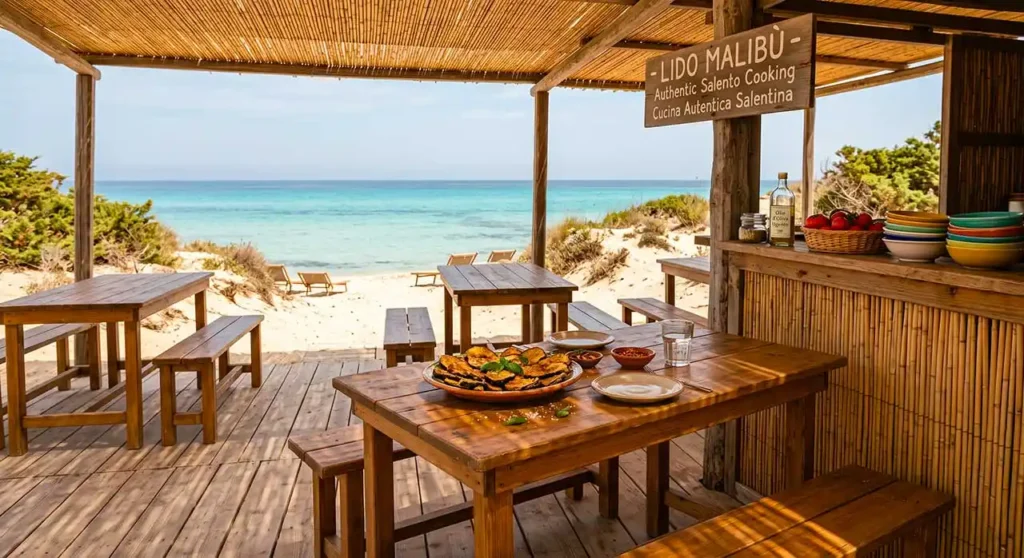
Our rush to the sea ended at Torre San Giovanni, amidst the wild, sweeping dunes of Lido Malibù. There, behind a wooden counter smelling of fresh tomatoes, garlic, and wild basil, we met Antonia—affectionately known by everyone here as “Tonia.” A formidable, radiant woman in her seventies, Tonia carries herself with the proud grace of someone who has breathed iodine and sea breeze her entire life.
She has been running this beach spot since Gloria was just a little girl, and over the decades, their bond has evolved into something much deeper than friendship.
Sitting at those wooden tables under the shade of the cane thicket, with sea salt still drying on our skin, Tonia served us her legendary melanzane fritte (fried eggplants). Golden, incredibly crispy on the outside, and melt-in-your-mouth soft on the inside, cooked to a secret recipe that tastes of home and history. That was my true Salentine baptism. Right then, I understood that Puglia isn’t just a destination—it’s a feeling.
Why Ugento is the Beating Heart of Authentic Salento
Located strategically halfway between the vibrant nightlife of Gallipoli and the dramatic cliffs of Santa Maria di Leuca, Ugento is a rare gem. Unlike the hyper-commercialized, crowded hubs of northern Puglia, this territory has fiercely preserved its rural, wild soul.
Here, the vibrant red soil meets twisted, centuries-old olive trees before gently sloping down toward a coastline of fine white sand and water so translucent it rivals the Caribbean. Ugento’s true magic lies in its dual soul: an ancient inland town steeped in Messapian mystery, located just minutes away from lush pine forests, natural wetlands, and pristine marine reserves.
The Best Beaches of Ugento (And How to Experience Them Without the Crowds)
Ugento’s coast stretches for several kilometers, offering a perfect balance of low-impact, friendly beach clubs and vast expanses of free, wild sands protected by delicate dune systems.
Torre San Giovanni and Lido Malibù
Torre San Giovanni is the main marina of Ugento. If you want the ultimate combination of untamed nature and warm, authentic hospitality, the dune area near Lido Malibù is where you want to be. The sand here is powdery and white, and the seabed is shallow and crystal-clear for meters out—perfect for relaxing.
- Local Insider Tip: Arrive early in the morning (around 8:30 AM) when the sea looks like a sheet of flat glass. Swim in the quiet water, and then head over to see Tonia at lunchtime for her home-cooked specialties.
Fontanelle and Torre Mozza: Pine Forests and Serenity
Heading south, the coast transitions into the quiet pine forests of Fontanelle and the historic sands of Torre Mozza. Fontanelle is backed by a thick, fragrant forest of maritime pines, offering a cool, shaded escape during the hottest hours of the day.
Torre Mozza gets its name from the ruined 16th-century coastal watchtower that stands sentinel right on the shoreline. It is a stunning, atmospheric spot where the Mediterranean scrub meets the sea.
| Beach / Location | Key Features | Vibe | Local Insider Tip |
| Torre San Giovanni (Malibù) | Wild dunes, shallow turquoise water, fine white sand | Authentic, warm, family-friendly | Try Tonia’s legendary fried eggplants for lunch! |
| Fontanelle | Expansive sand, backed by a deep, fragrant pine forest | Relaxed, natural, spacious | Bring a hammock or a blanket and enjoy a midday siesta under the pines. |
| Torre Mozza | Dominating historic watchtower, exceptionally clear sea | Scenic, quiet, historical | Perfect for a late afternoon swim and watching the sunset frame the ancient tower. |
Stepping Back in Time: The Historic Center of Ugento
When the sun begins to soften, leave the coast behind and head inland. Just a few kilometers up the hill lies Ugento’s historic core, built of pietra leccese—a local golden limestone that glows warmly in the late afternoon light. This town was once a powerful Messapian stronghold, centuries before the Romans arrived.
The Castle of the d’Amore Family
Dominating the highest point of the town, this imposing castle has been beautifully restored. Originally built as a Norman military fortress, it was transformed into a luxurious aristocratic palace by the d’Amore marquises in the 17th century. Walking through its frescoed halls feels like stepping directly into the secrets of Salentine nobility.
The “Salvatore Zecca” Archaeological Museum
Housed in a beautiful, quiet former Franciscan monastery (Santa Maria della Pietà), this museum holds one of the most important archaeological collections in the region.
The crown jewel is the magnificent bronze statue of the Zeus of Ugento, dating back to the 6th century BC (the original is in Taranto, but the incredibly detailed replica here is breathtaking). You can also walk right beside painted Messapian tombs dating back over 2,500 years.
Gloria’s Hidden Secret: La Cripta del Crocifisso
Just outside the town center, along the ancient rural path to Casarano, lies the Crypt of the Crucifix. This is an extraordinary, subterranean chapel carved entirely out of the soft tufa rock.
The walls and ceilings are covered in striking Byzantine-style frescoes dating from the 13th to the 17th centuries, featuring painted stars, templar knights, and medieval shields. The atmosphere inside is intensely mystical.
- How to visit: It is often locked to preserve the frescoes. Ask the local tourist office (Pro Loco) in town to arrange an opening—it’s a hidden treasure that 99% of tourists completely miss!
Felline: The Medieval Culinary Capital of Basso Salento
Only five minutes by car from Ugento is Felline, a tiny medieval village that feels completely untouched by time. Clustered around a sturdy baronial castle and the quiet Church of San Leucio, this village has quietly built a reputation as the “gastronomic capital” of the area.
On summer nights, Felline transforms. The narrow, white-stone streets are closed off, and local restaurants set up outdoor tables under strings of warm, glowing lights. There are no tourist traps here—only authentic, seasonal, country-style cooking.
Our Absolute Favorite Spot: L’Antico Monastero
Whenever our close friends ask us where to get a truly exceptional, unforgettable meal without breaking the bank, we send them to L’Antico Monastero.
Located right in the heart of the historic Piazza Castello, this rustic and welcoming restaurant is set inside a gorgeous historical building.
Sitting outside in the square, eating by candlelight surrounded by ancient stone walls, is an experience you will talk about for years.
The restaurant is run by dear friends of ours, and the level of care and quality they put into their food is outstanding. The prices are incredibly honest, and the atmosphere feels like a warm family dinner.
What You Must Order at L’Antico Monastero:
- Orecchiette and Minchiareddri: The absolute queens of Salentine pasta, handmade by local women and served with a rich, slow-simmered tomato sauce, tiny savory meatballs, and a touch of local cheese fonduta.
- Pitta di Patate: A classic peasant-style potato pie filled with sweet, slow-cooked onions, black olives, capers, tomatoes, and a hint of anchovy. It is savory, comforting, and deeply traditional.
- The Wood-Fired Pizza: If you are in the mood for pizza, their traditional wood-fired oven turns out some of the lightest, most delicious, and perfectly blistered pizzas in the entire region.
How to Experience Basso Salento Like a Local: Our 3 Golden Rules
To make the most of your time in our home region, follow these three simple rules that we live by every single day:
- Follow the Wind: In Salento, the wind decides your beach. If the dry northern wind, the Tramontana, is blowing, the Ionian Sea (including Ugento’s beaches) will be flat, crystal-clear, and calm like a swimming pool.
If the southern Scirocco is blowing, the Ionian will be rough—that is your cue to drive to the Adriatic coast (like Castro or Porto Badisco) for calm water. When exploring the local coast, don’t just pick a random spot on the map. In Salento, the wind rules the sea. Check out our comprehensive [Ugento beach wind guide] to plan a flawless day under the sun - Respect the “Controra” (The Sacred Afternoon): Between 2:00 PM and 5:00 PM, the towns completely empty out, shops close, and a deep silence falls. This is the controra. Do not try to sightsee during these hours. Rest, read a book in the shade of an olive tree, or take a nap. Embrace the slow pace.
- Buy Olive Oil Directly from a Mill (Frantoio): Never buy olive oil from a supermarket. Ask a local or drive into the countryside around Ugento to find a local frantoio (olive mill). Buying a tin of cold-pressed extra virgin olive oil directly from the producer supports the local economy and brings the true taste of Salento back home with you.

5 thoughts on “The Ultimate Ugento Travel Guide: Wild Beaches, Ancient History, and Slow Food in Salento”