Some trips are about the destination. Others are about everything that happens before you get there — the wrong turns, the impromptu stops, the smell of pine trees mixing with woodsmoke at midnight. Our trip to Gallipoli was the second kind, and honestly, we wouldn’t want it any other way.
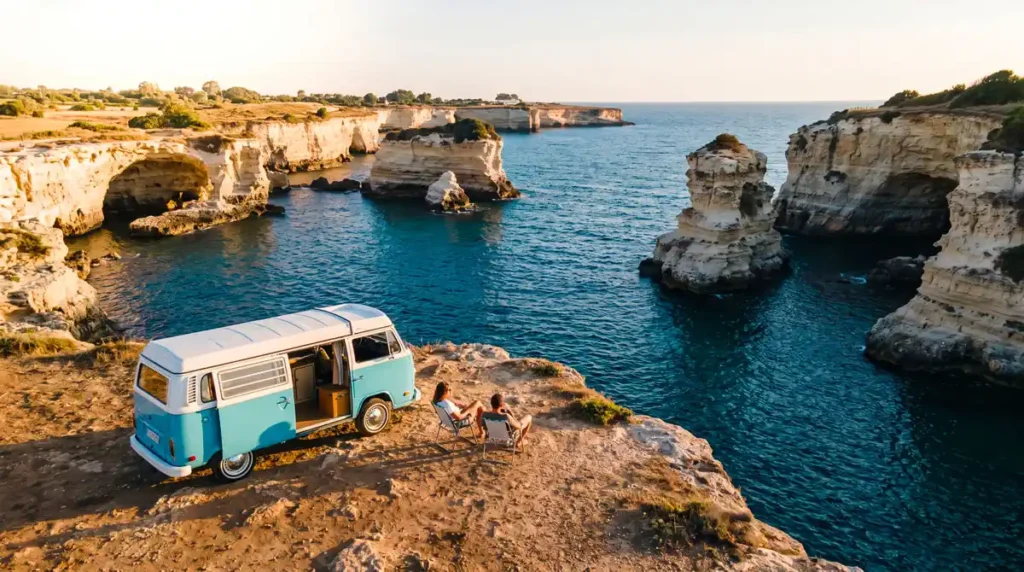
We’d been talking about Gallipoli for months — that legendary stretch of Ionian coast with its old town rising out of the sea like something from another century, its beaches that turn an impossible turquoise in the afternoon light. But rather than driving straight there in a couple of hours, as any sensible person with a normal car might do, we decided to turn it into a proper journey: three days, no fixed itinerary, just us, the van, and a general direction.
Leaving Ugento Behind
We left early, right after coffee, with the back of the van loaded the way it always is before a trip: too many blankets, not quite enough food, and a small cooler dedicated entirely to meat for the grill — because if there’s one thing we never travel without, it’s the ribs. Gloria had marinated them the night before with garlic, rosemary, a little local olive oil, and enough black pepper to make the whole van smell like a restaurant kitchen by the time we hit the road.
Ugento disappeared behind us slowly, the way small towns do when you’re not in a rush. The road south of Salento has that particular quality of feeling both empty and alive — olive groves stretching out on either side, dry stone walls running along the fields, the occasional trullo-like structure appearing and disappearing behind the trees. We didn’t have a fixed idea of where we’d stop for the first night. That was, in a way, the whole point.
First Stop: A Sosta Camper Near the Coast
By early afternoon, we found what we were looking for almost by accident: a small, informal area di sosta just off the coastal road, the kind of spot that doesn’t appear on every map but that camper owners somehow always find each other in. It wasn’t glamorous — just a flat gravel clearing shaded by a handful of pine trees, close enough to hear the sea but far enough that we couldn’t see it directly.
There were already two other vans parked when we arrived, spaced out with that unspoken van-life etiquette of giving each other enough distance to feel private. We exchanged a wave with our neighbors — a German couple traveling with a dog who seemed far more interested in our cooler than in us — and set up camp for the afternoon.
This is one of the things we’ve come to love most about traveling this way through Puglia: the informal aree di sosta, often free or nearly free, scattered along the coast and inland roads, offer a kind of freedom that structured campsites can’t always match. No check-in desk, no fixed hours, just a flat patch of ground and the implicit agreement that everyone there is looking for the same thing — space, quiet, and a decent view.
The Pine Forest Ritual
As the afternoon light began to soften, we did what we always do when the setting allows it: we found a spot among the pine trees, cleared a small patch of ground, and set up the portable grill. There’s something almost ceremonial about this part of the day. Gloria arranges the folding table with plates that never quite match, I deal with the charcoal, and somewhere in between, the first smell of woodsmoke starts drifting through the pines.
The ribs went on slowly, over low heat, the way they’re supposed to — no rushing, no flipping every thirty seconds out of impatience. We let them sit, occasionally basting them with the leftover marinade, while the light filtering through the pine branches turned from white to gold to a deep amber that made everything, including the smoke itself, look cinematic.
Cooking in a pine forest does something to the food that’s hard to explain until you’ve experienced it: the resin in the air, subtle as it is, seems to fold itself into the smoke, adding a note you’d never get from a regular backyard barbecue. By the time the ribs were ready, caramelized and falling off the bone, we’d already opened a bottle of local primitivo and set our chairs facing the last of the daylight filtering through the trees.
We ate slowly, the way you only really can when there’s nowhere else to be. The German couple’s dog eventually gave up on subtlety and came over directly, and we ended up sharing scraps and stories with our temporary neighbors — that particular kind of instant camaraderie that seems to exist only among people traveling the same way, with the same kind of freedom.
Night in the Pines
Sleeping in a pine forest near the coast has a rhythm all its own. The wind moves through the branches in long, soft waves, completely different from the sharper sound of wind over open water. Somewhere far off, we could hear the sea, faint and constant, like a low bassline under the rustling of the pines.
We left the van’s roof vents cracked open, enough to let in the smell of pine resin and salt air without letting in the mosquitoes, and fell asleep almost embarrassingly early, worn out from driving, cooking, and the particular kind of tiredness that only a day outdoors can produce.
Second Day: Toward the Coast Road to Gallipoli
The next morning started slowly, the way mornings in a van always do — coffee first, actual conversation second. We packed up without much urgency, said goodbye to our temporary neighbors, and continued south along the coastal road toward Gallipoli, taking every detour that looked even remotely interesting.
This stretch of coast, moving from the Ugento marina toward Gallipoli, is dotted with small watchtowers, hidden coves, and every so often, another informal sosta camper tucked between the dunes and the pine woods that run almost continuously along parts of this coastline. We stopped more than once just to look at the water — that particular Ionian blue that seems to get more intense the closer you get to Gallipoli itself.
By midday, we’d reached one of the larger organized campsites just outside the old town, the kind with proper facilities: hookups for water and electricity, showers, a small on-site shop, and — crucially, after two days of informal stops — a place to properly empty the van’s tanks. There’s a practical side to van life that no romantic story should skip over, and finding a well-run campsite every few days to reset, recharge, and restock is simply part of doing this well.
Choosing Between Campsites and Free Stops
One of the questions we get asked most often is how we decide between paying campsites and free aree di sosta, and the honest answer is that it depends entirely on what we need that day. Organized campsites near Gallipoli tend to offer full services — electricity, water, waste disposal, sometimes a pool or a small restaurant — which makes them ideal every few days, especially if you need to do laundry or simply want a proper shower.
Free or low-cost aree di sosta, on the other hand, are perfect for the nights that matter most to us: the ones where we want silence, pine trees, and a view instead of a fence and a reception desk. The trade-off is obvious — fewer services, sometimes no toilets, and the need to be more self-sufficient — but for us, that trade-off is almost always worth it. We tend to alternate: two or three nights in the wild, one night at a proper campsite to reset everything.
Arriving in Gallipoli
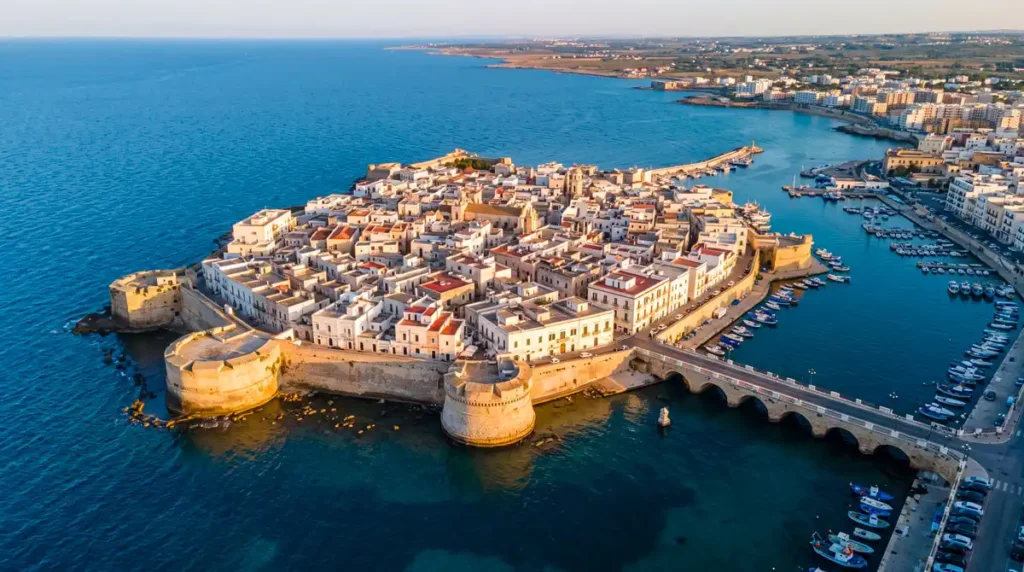
We saved the actual entrance into Gallipoli for the late afternoon, timing it deliberately so we’d arrive as the light started turning gold. And it worked exactly as we’d hoped: crossing onto the small island that holds the old town, with the sea on both sides and the pastel-colored buildings catching the last direct sunlight, felt like arriving somewhere that had been waiting specifically for that hour.
We parked the van at a designated area just outside the historic center — driving into the old town itself isn’t really an option, nor should it be, given how narrow and pedestrian-focused those streets are — and walked in on foot, the way Gallipoli is meant to be experienced. The old town felt exactly like the photos, but somehow more alive: fishermen still working near the harbor, the smell of frying seafood drifting from small trattorias, kids playing in the narrow streets between laundry lines strung from balcony to balcony.
Sunset on the Ramparts
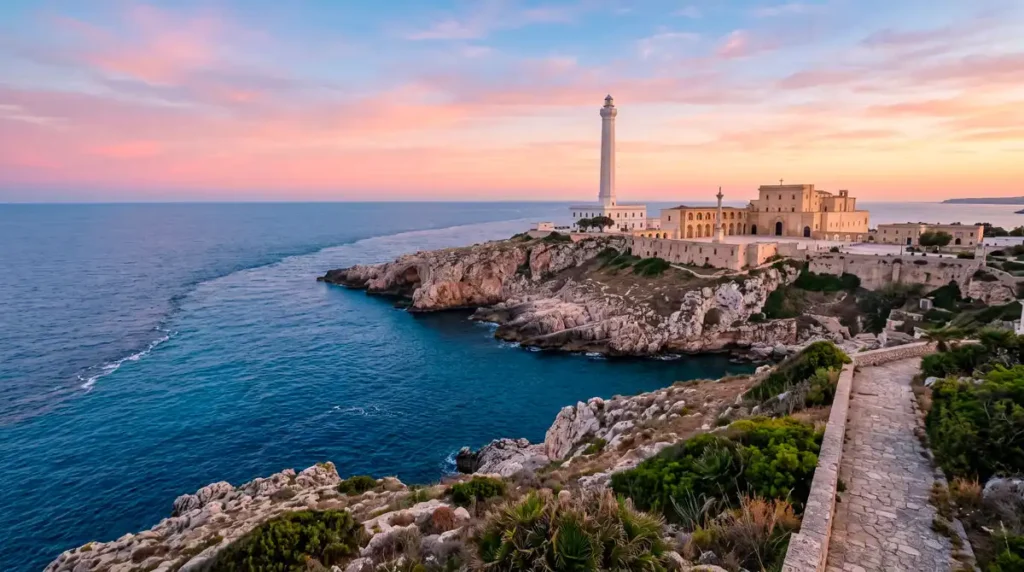
Gallipoli’s old town is almost entirely surrounded by defensive walls built directly into the rock facing the sea, and by early evening, those walls fill with people who all seem to have the same idea we did: watching the sunset from the water’s edge, with the Ionian Sea turning gold, then pink, then a deep violet as the sun dropped behind the horizon.
We found a spot on the walls near the old lighthouse, sat down with nothing but a bottle of water and the quiet exhaustion of two days on the road, and watched the whole thing happen the way you watch something you know you’ll remember later. Somewhere behind us, someone was playing a guitar, badly but earnestly, and the whole scene felt less like a tourist postcard and more like something genuinely, unpretentiously alive.
A Final Night by the Pines Before Heading Back
Rather than driving straight back to Ugento the next day, we decided to retrace part of our route and spend one more night in the pines, close to where we’d started. It felt right to close the loop the same way we’d opened it: charcoal, ribs, and the particular quiet of a pine forest at night.
This time, we knew exactly what we were doing — the marinade was better, the fire was managed with the confidence of people who’d done this once already on this same trip, and the ribs came out even better than the first night, if that’s even possible. We sat under the trees long after the food was gone, listening to the wind and, somewhere in the distance, the faint sound of the sea we’d traveled three days to properly meet.
What This Trip Taught Us About Traveling Slowly
Looking back, the actual time spent in Gallipoli itself was almost the smallest part of the trip. What we remember most vividly are the in-between moments: the informal sosta camper we stumbled into by accident, the smell of pine resin mixing with woodsmoke, the German couple’s dog stealing scraps of rib meat, the sunset from the ramparts, and the quiet satisfaction of falling asleep to the sound of wind moving through pine branches instead of traffic.
This is, in many ways, exactly why we chose this life. Not because every destination in Puglia is spectacular — though many are — but because the way you get there, slowly, with no fixed schedule and a grill in the back of the van, changes what the destination even means. Gallipoli was beautiful. But the three days it took us to properly arrive there were, in their own quiet way, just as memorable.
If you’re planning a similar trip along this stretch of coast, our advice is simple: don’t rush it. Build in time for the pine forests, the informal stops, and at least one proper night spent cooking slowly under the trees before you ever reach the destination. That’s where the real story of a road trip through Puglia actually happens.

1 thought on “On the Road to Gallipoli: A Van Life Journey Through Pine Forests, Campsites, and Grilled Ribs”